
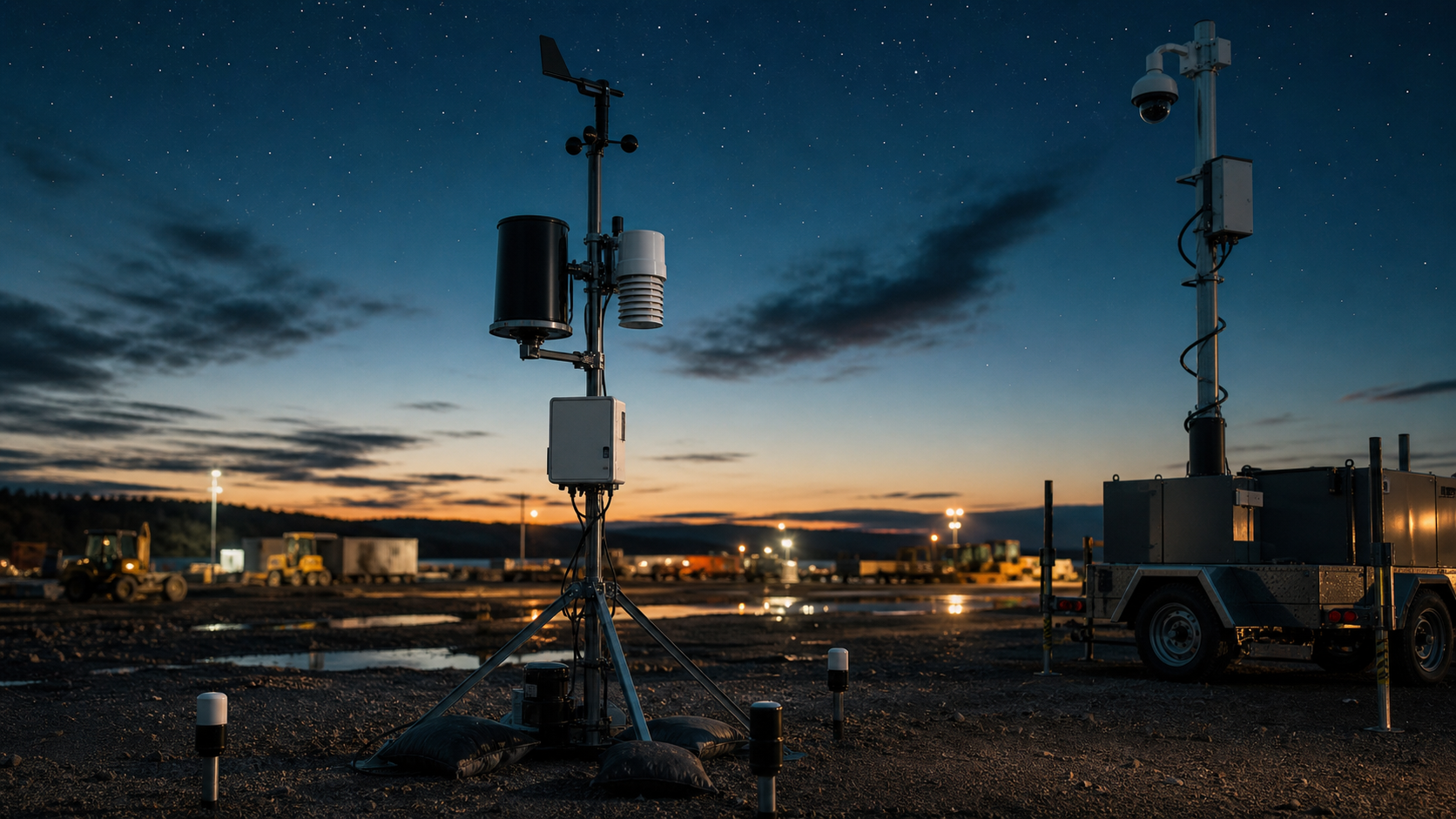
Sensing & IoT

The camera is one sensor. Give the site its full nervous system.

Gates, tanks, temperature, weather, doors, power—SurveillX ingests the signals a camera cannot see, alerts on the change that matters, and stores every reading beside the footage it explains.

Sensing layers

Owned on the node. Recorded with the video.

Sensor hardware is enabled per deployment. Device classes are supported through standard decoding; individual models are validated against the site's equipment.

01 / LORAWAN

Your sensor network. No vendor cloud.

SurveillX nodes can run a complete LoRaWAN network server on-site. Long-range, battery-powered sensors join a network you own—managed through the same console, APIs, and AI tools as the rest of the platform, with no per-site sensor-cloud subscription and no dependency on an internet path just to hear a door open.
Embedded network serverA full LoRaWAN stack (ChirpStack v4) on the node itself—gateways, applications, and devices under local control.Deployment-specific
Device lifecycleProvision, key, rename, and retire devices; manage device profiles and payload decoders through console, API, or governed AI tools.Deployment-specific
Auto-registrationKnown device types appear on first uplink with decoded readings—no per-device onboarding ceremony.Available
Downlinks + groupsQueue commands to a single device or multicast groups for configuration and control use cases.Deployment-specific
Decoded historyEvery uplink is decoded, stored, and queryable—signal quality and battery state included.Available
Managed remotelyThe entire LoRaWAN estate is visible and manageable through the fleet surface—no site visit to add a sensor profile.Available
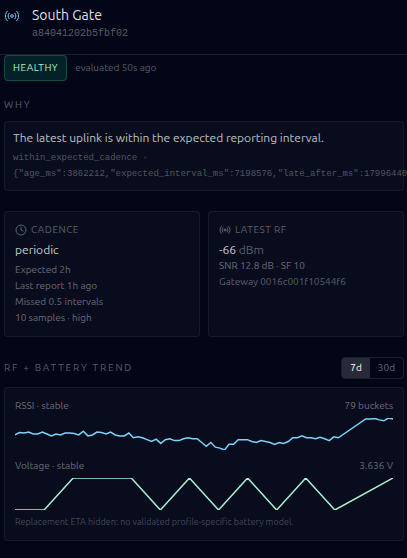
Per-device health card for a gate door contact: healthy status with an explanation, reporting cadence, RF signal quality, and RSSI and battery voltage trends
02 / WEATHER

On-site weather, not the nearest airport.

Direct-wired professional weather stations give the site its own measured truth—wind, rain, temperature, humidity, pressure, light—refreshed continuously and paired with every recording. Forecast data fills in what instruments cannot: what is coming next.
Direct-wired stationsIndustrial weather stations (SenseCAP ONE family) connected to the node over serial—no radio dependency, sub-second live readings.Validated hardware
Wind that keeps upFast wind sampling captures the gust peaks slower systems alias past—relevant for crane holds and lift decisions.Validated hardware
Derived windowsRolling 1-hour and 24-hour rainfall and gust maxima computed on the node, reset-safe.Available
Charted historyEfficient change-based storage with server-side downsampling keeps months of readings chartable in one request.Available
Forecast blendHourly and daily forecast at the node's GPS position complements measured conditions.Available
Wireless weatherLoRaWAN weather-station classes ride the same ingest path where wiring is impractical.Supported class
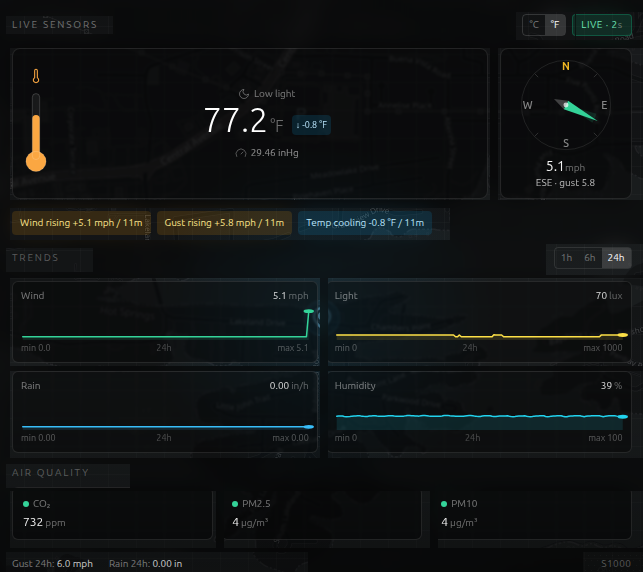
Live sensor dashboard showing temperature, wind compass, 24-hour wind, light, rain, and humidity trends, and air quality readings with a live freshness badge
03 / ALERTING

Alert on the change, not the heartbeat.

Sensor alerting is edge-triggered: a gate left open alerts once when it opens—not on every battery-saving heartbeat the device sends for the next six hours. Thresholds, liveness, and delivery all run on the node, so alerting works even when the backhaul does not.
Per-device thresholdsMin/max bounds per metric per device, with re-notify intervals when a sustained breach should keep escalating.Available
Edge-triggered logicAlerts fire on the breach transition. Open and close are each one event, regardless of how chatty the device is.Available
Multi-channel deliveryOne threshold event fans out to signed webhooks, email/SMS paths, and the live operator view simultaneously.Available
Door-contact flowThe full open/close alert chain is field-validated on real contact hardware.Validated hardware
Two-layer livenessSensor-offline and node-offline are separate signals—a quiet sensor is not mistaken for a dead site, or vice versa.Available
Physical responseConfigured deployments can connect events to on-site outputs—relays, lights, sirens, and audio talk-down.Deployment-specific
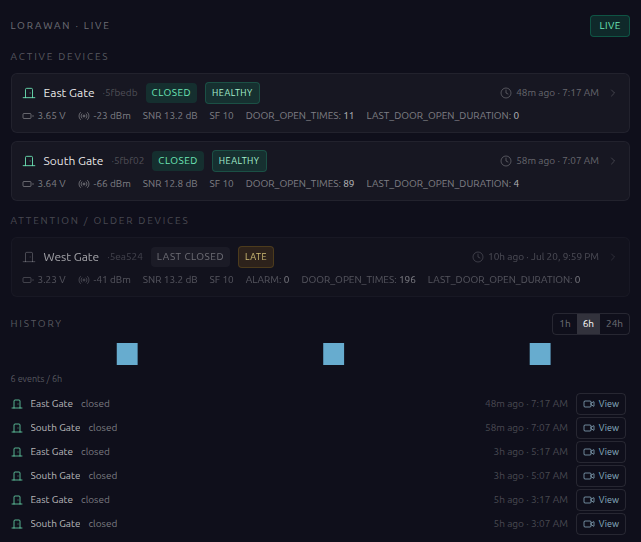
Live LoRaWAN device panel showing gate door contacts with health status, battery, signal quality, open counts, a late-device attention state, and an open/close event history
04 / SENSOR MESH

Satellites report to the hub.

Not every measurement point deserves a full camera node. Sensor-only satellites—a weather station on a far corner, instruments at an outbuilding—forward their readings to a hub node over whatever backhaul exists, with delivery guarantees designed for links that fail.

Forward-mode nodesA satellite node replays its stored readings to a hub's authenticated ingest—the hub sees one merged sensor picture.Deployment-specific
Durable backfillDelivery tracks a durable high-water mark: an outage queues readings locally and flushes on recovery. No reading lost.Available
Authenticated ingestPer-node tokens scope exactly which node may publish which data—rotation and revocation included.Available
Any backhaulLAN, cellular, or tunnel—the satellite only needs an outbound path to the hub.Available
05 / AIR QUALITY

The air is part of the record.

Dust complaints, wildfire smoke, and enclosed-space ventilation are field decisions long before they are paperwork. On-site CO₂ and particulate readings—beside the cameras that show the cause—give teams early warning and honest documentation. These are indicative sensors for awareness and evidence, not certified compliance instrumentation.

Continuous CO₂ + PMCO₂, PM2.5, and PM10 measured by the same on-site weather station—no separate air-quality deployment.Validated hardware
Video-correlated spikesA particulate spike has a timestamp, and the timestamp has footage. See what was happening on site when the reading changed.Available
Dust awarenessTrack PM10 through demolition, earthmoving, and cutting so mitigation decisions come before the complaint does.Available
Smoke daysSite-local PM2.5 supports outdoor-work decisions during wildfire smoke—better than a reference station miles away.Available
Threshold alertsAir-quality metrics ride the same edge-triggered alerting path as every other sensor—webhooks, email/SMS, live view.Available
Trend historyStored readings with charted 1h/6h/24h views document conditions over the full work window.Available
06 / USE CASES

What a site can sense.

Anything that speaks LoRaWAN or wires to the node can join the record. Classes below marked “validated” run in the field today; “supported class” devices use standard decoding and are validated per deployment.

Gate + door contactsAfter-hours access, open-too-long conditions, container and shed security.Validated hardware
Weather stationsWind holds, rain thresholds, lightning-adjacent decisions, documentation for delay claims.Validated hardware
Tank + fuel levelGenerator fuel, water tanks, and consumable levels without a drive-by.Supported class
Temperature + cold chainMaterial storage, curing conditions, refrigerated assets, freeze warnings.Supported class
Water leak + moistureLeak detection in temporary facilities, soil and slab moisture context.Supported class
Air qualityCO₂, PM2.5, and PM10 from the on-site weather station; standalone LoRaWAN air sensors as a supported class. See air qualityValidated hardware
Vibration + equipmentRuntime and condition signals from pumps, generators, and rotating equipment.Supported class
Occupancy + countingPresence and utilization signals for offices, laydown areas, and access points.Supported class

How sensing flows

From radio to record to response.

The hot path is local: readings are decoded, stored, and evaluated on the node. Delivery happens where you configure it.

Field sensors

Signals

  • LoRaWAN devices — battery-powered, long range
  • Wired weather station
  • Digital I/O contacts
  • Satellite sensor nodes
The node

Local truth

  • Decode + store on-site
  • Thresholds evaluated at the edge
  • Two-layer liveness tracking
  • Recorded beside the video timeline
Response + review

Delivery

  • Live operator view
  • Signed webhooks + email/SMS
  • APIs + governed AI agents
  • Charted history + reports
“A camera tells you what happened in its field of view. Sensors tell you what happened everywhere else.”
SurveillX platform principle · one record for the whole site

Instrument the site

Tell us what you need to know about your site.

We'll map the sensors, radio coverage, alert routing, and validation plan to get it onto the same record as your cameras.